
July 2026 Newsletter
Dear PAAWBAC Community,
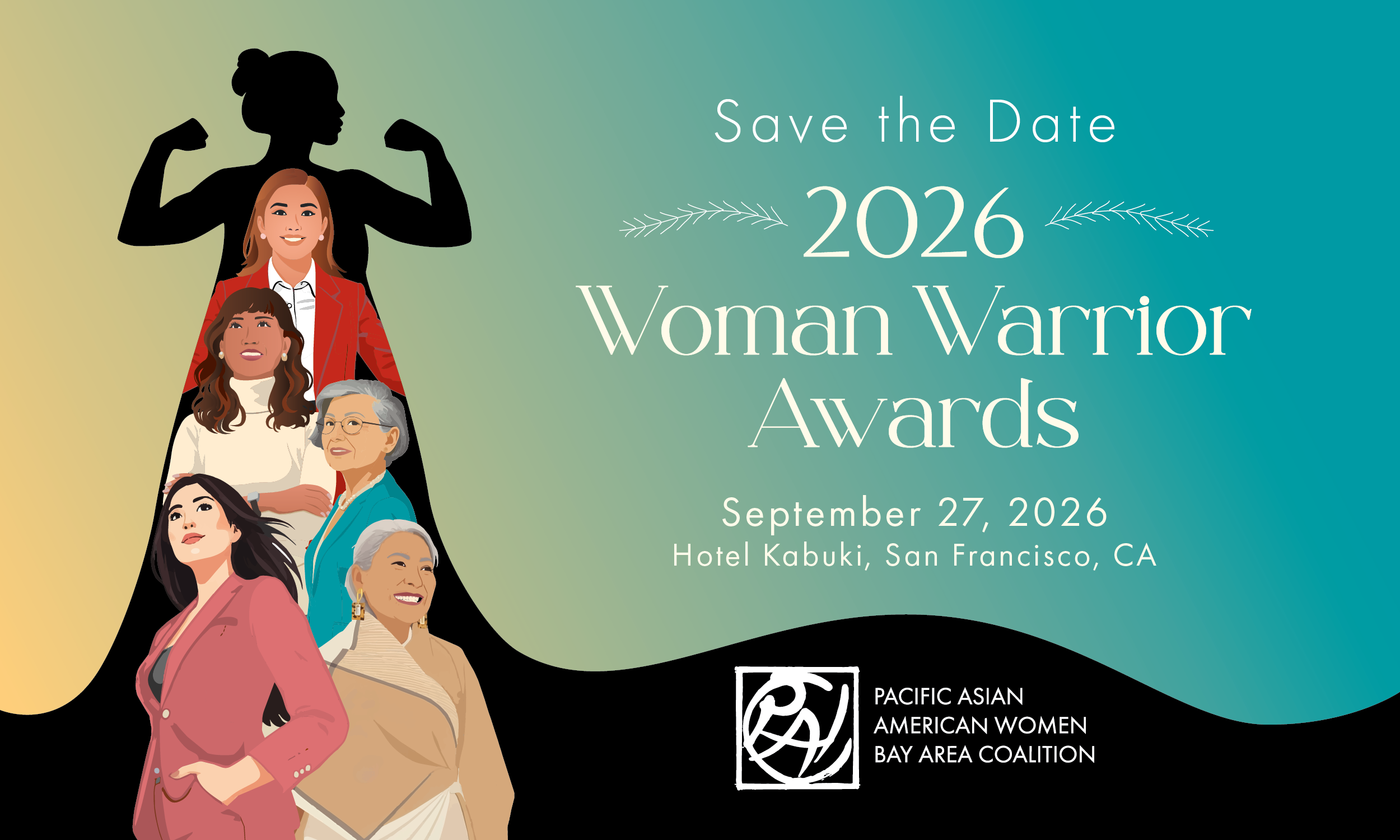
We are excited to offer event sponsorship opportunities to support PAAWBAC and to show up for our amazing 2026 Woman Warriors at our awards ceremony luncheon Sunday, September 27th, 2026 at Hotel Kabuki in San Francisco, CA. Please see levels and benefits below.
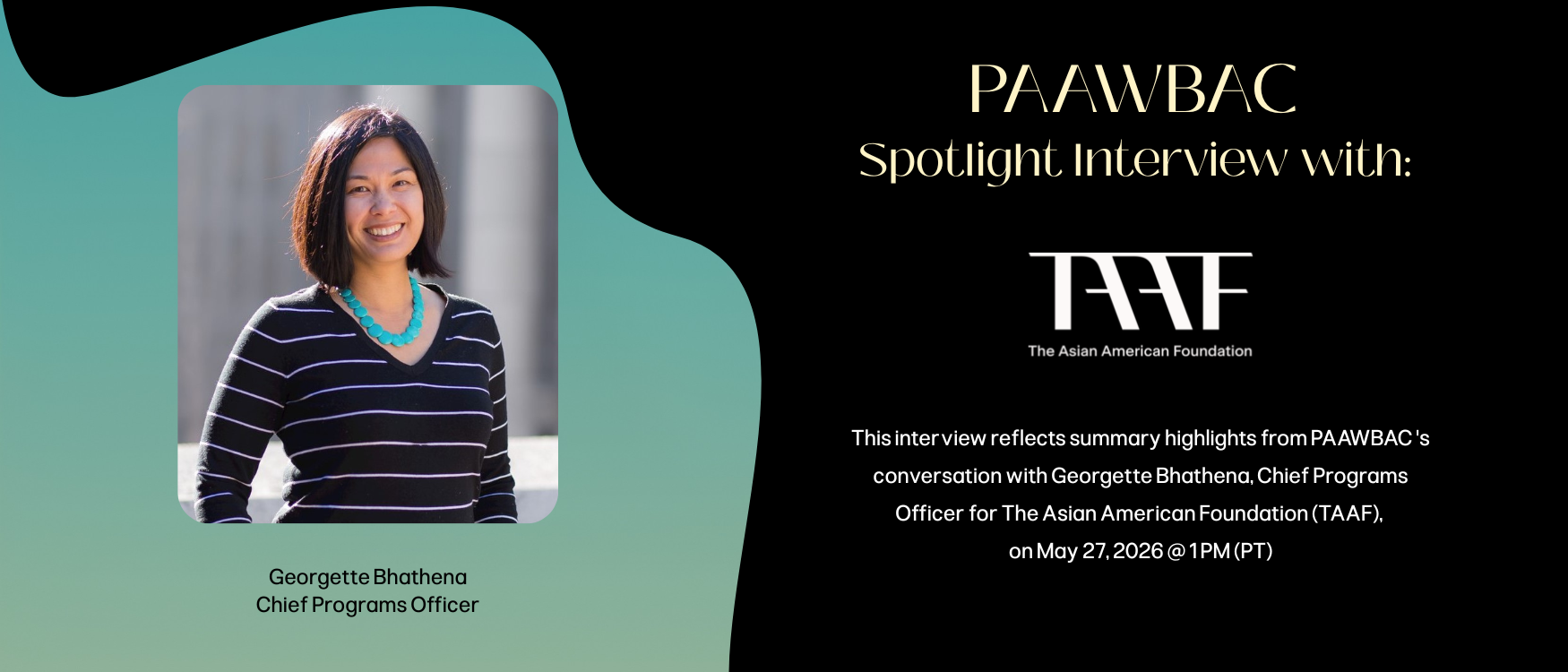
In this newsletter, we are happy to feature our Peony sponsor, The Asian American Foundation (TAAF), and to bring to you a Spotlight Interview with TAAF’s Chief Programs Officer, Georgette Bhathena. Thank you to Georgette and TAAF for your generosity of time and support! We are buoyed by your support and look forward to collaborating with TAAF in the Bay Area.
For full details on event sponsorship opportunities and our 2026 Woman Warrior honorees, please see here. If you would like to join as a sponsor at any level, please visit our events page and sign up directly. Or if you prefer to pay by check, please email us to let us know at paawbac@gmail.com and mail the check to P.O. Box 640825 San Francisco, CA 94164.
Introduction
PAAWBAC board members Theresa Lee and Elsie Lum welcomed Georgette Bhathena, Chief Programs Officer at The Asian American Foundation (TAAF), to share more about TAAF’s mission of safety, belonging, and prosperity and its plans for the San Francisco Bay Area.
PAAWBAC expressed appreciation for being one of 13 local SF Asian American Pacific Islander (AAPI) organizations, who were recently awarded a grant by TAAF and the SF Asian American Voices Initiative. During this conversation, PAAWBAC shared our 45-year history of uplifting AAPI women through programs like the Woman Warrior (WW) Awards, mentorships, and our inaugural Young Leaders program.
1. Please tell us briefly about yourself, TAAF, and your role in TAAF
Georgette was hired as TAAF’s first Chief Programs Office over 3.5 years ago and has over 20 years in the philanthropic area. She was raised in Seattle in a multi-ethnic family (her parents are of Indian, Filipino and Chinese backgrounds). She shared how her family emphasized assimilation for success and how it raised questions within herself as to what that meant, specifically where did she belong as a multi-ethnic person. It wasn’t until she was at the University of Washington and taking ethnic studies that she understood the full impact of AAPI contributions to American history. Specifically, she realized that the AAPI community was a part of American history and not separate but belonged in America. This sense of belonging is a key pillar of TAAF’s mission.
TAAF was founded in 2021 in response to rising anti-Asian hate by focusing on anti-hate education, narrative change, and resource representation. In 2025, they started the TAAF Cities initiative to accelerate public and private investments in cities with large AAPI populations and improve local public safety, boost economic opportunity and revitalize historic neighborhoods. These cities represent areas that will be part of a national network where each region can learn, advocate and collaborate on AAPI issues while addressing safety, belonging and prosperity. Georgette shared that AAPI communities have historically received only 0.4% of private philanthropic grants. A datapoint that TAAF is committed to change through its advocacy and education.
2. How did the San Francisco Bay Area become a target for TAAF's involvement, such as its collaboration with SF Asian American Voices?
Georgette explained that TAAF’s work in San Francisco began through a partnership between TAAF President Norman Chen and Garry Tan, founder of the Asian American Voices Foundation (AAVF). By providing the administrative and grant making infrastructure for funds raised by AAVF, TAAF helped distribute over $350,000 to 13 local grassroots community-based organizations (CBOs). Looking ahead, TAAF aims to strengthen its national network of CBOs and increase its local presence in the Bay Area to better advocate on mutual issues, including support and services for AAPI women. However, future funding and activities will depend on research and data gathering to ensure that resources are appropriately distributed. TAAF plans to partner with research firms and academic researchers to provide the data to guide their work.
3. Why did TAAF select PAAWBAC for this first funding group? What are TAAF’s priorities and future plans for collaborations in the SF Bay Area?
As part of the “pilot” funding group in the SF Bay area, PAAWBAC was strongly recommended by community members as a long-standing force for AAPI women, representing AAPI women for the past 40+ years. Georgette shared that PAAWBAC and other community organizations were selected due to informal feedback and verification from the advisory group. The selection panel looked at applicants’ impact on TAAF’s priorities of Safety, Belonging, &/or Prosperity, as well as representing diverse groups, i.e., women, seniors and diverse community services. TAAF’s plans will include collaborations in the SF Bay Area in 2027, with a more formal RFP process based on recent research on future needs.
4. From the recent TAAF 2026 Heritage Month Summit, what priorities and strategies emerged for TAAF to address AAPI issues? Anything specific to AAPI women’s issues?
Georgette shared that the TAAF 2026 Heritage Month Summit was really a large plenary session of speakers and panels with diverse stakeholders from various backgrounds. No specific program ideas emerged since the goal of the summit was to create a sense of belonging across these diverse sectors, with representation for all perspectives. Perhaps the next summit will have both a general plenary session and smaller breakout discussions that focus more on specific issues and programs.
5. Where do you see TAAF’s greatest contributions to the AAPI Community, specifically in the SF Bay Area in 5 years (and will women issues be a priority)?
Building on TAAF’s recent summit, the focus will be an “Asian + American” (dual identity) theme for the 250 th anniversary of America. Georgette shared that going forward, TAAF wants to create more resources for the Asian American Native Hawaiian Pacific Islander (AANHPI ) communities, based on data to build coalitions where needed. All programs will focus on the priorities to build safety, belonging, and prosperity. Georgette emphasized public-private partnerships to revitalize areas with large enclaves of AANHPI communities. Ideally, these partnerships would increase leadership for practices and services to these communities.
6. Since TAAF is highly visible on the East coast, how will TAAF ensure it keeps on top of issues here at the local level and proactively collaborate with local AAPI organizations in a timely manner?
TAAF will be focusing on 4 cities; In 2026 the focus will be on Seattle and New York City, and in 2027, on San Francisco and Los Angeles. To help serve the West coast cities, TAAF will be hiring a West Coast coordinator. Why was Seattle selected first? Seattle has a large AANHPI community; it’s a mid-size city (more manageable), with a partnership with Starbucks and other possible funding partners. Also, TAAF has many personal connections, especially with Georgette having grown up and worked in Seattle.
Concluding Comments
Moving forward, TAAF wants to build more representation and belonging for the AANHPI communities, through connections with each other and sharing their journeys. “TAAF wants to build and support local programs in AANHPI regions throughout the US.”
Theresa and Elsie thanked Georgette for her time for sharing her personal story and TAAF’s future plans. All looked forward to celebrating AAPI women at PAAWBAC’s Woman Warrior Awards Luncheon on September 27, 2026, at the Hotel Kabuki in SF Japantown.